Sunday, December 4, 2016

Friday, February 5, 2016
Thursday, January 28, 2016
Monday, January 18, 2016
Thursday, January 10, 2013
Thursday, June 14, 2012
Persuasion
One can expect to successfully persuade those who accept his premises and understand his reasoning.
Unfortunately, those are rarely the people one is trying to persuade.
Monday, January 31, 2011
Sunday, October 17, 2010
epiphanies
We expect to have epiphanies, because we presume that life follows a causally-determined narrative; It doesn't, so we don't.
Monday, July 5, 2010
ideal
The term "ideal" can be used by the same mind as a derison and a laudable endpoint. Perhaps this reflects the human mind's ability simultaneously know its limitations but desire to escape them.
If contradiction does not reside in the heart of men then I don't know what does.
If contradiction does not reside in the heart of men then I don't know what does.
Wednesday, June 30, 2010
If religion the opiate of the masses then philosophy is the opiate of the intelligentsia. Today I seek solace from the futility of my endeavors and find it first in Spinoza then other stoics. I plea with my wife, but she is entirely too well-grounded to supply my errant grasps with scaffolded grapples.
Thursday, August 6, 2009
Monday, August 3, 2009
Is there a difference between making typo and making an error in your math?
Your answer to that question may determine your answer to this one: Are mathematical* theorems discovered or created?
------------------------------------------------------------------
And if you're a redunctionist then by extension the laws of physics, the principles of chemistry, the observations of biology...
*One who holds the belief that all phenomena can be reduced to a fundamental^ explanation.
^Which would mean it is not further reducible, and I s'pose we'd expect it to be consistent.
Your answer to that question may determine your answer to this one: Are mathematical* theorems discovered or created?
------------------------------------------------------------------
And if you're a redunctionist then by extension the laws of physics, the principles of chemistry, the observations of biology...
*One who holds the belief that all phenomena can be reduced to a fundamental^ explanation.
^Which would mean it is not further reducible, and I s'pose we'd expect it to be consistent.
Monday, July 13, 2009
Objective Reality – A Yardstick Or an Illusion?
This is just a preamble.
Where you witness something unbelievable, what would you first do? You might first rub your eyes, pinch your skin, or do something else to guage the faculty of your senses, if these fail to help you reconcile your observation with your beliefs eventually you would likely look to someone or something outside yourself to confirm or disconfirm your sensory input. This is because most of us trust our senses as far as they confirm our prejudices, but when our senses do not confirm our suspicions we seek a “reality check”. In this sense “Reality” is a yardstick.
If you are willing to discard your prejudices when they do not agree with observation then you may be considered an Empericist. If you can do this dutifully, damn the consequences to your worldview, I commend you, though I may or may not agree with you - I am presently undecided on this particular issue.
But what if what you observe defies any logical explanation? What if even the most self-evident premises must be discarded as a result of what you see, would you sooner discard your axioms or your eyes?
In order to shed some light, or, rather, cast some shadows on 'Reality' I would like to refer you to the wave vs the particle nature of light, the double-slit experiment, and the Law of the Excluded Middle (LEM).
So - Light – a wave or a particle?
You are likely familiar with this question, and it's answer, both. If so, you can skip this section.
First, why the either or w/r/t wave vs particle - can it be both? Well, wave and particle natures seem to be mutually exclusive. To try and skirt the issue with a linguistic sleight of hand like, "it's a wave of particles" wont work. Waves can travel through a medium composed of particles, but those particles are not the wave. Waves are spread-out, continuous, while particles are discrete, discontinuous. It seems that one thing can not be both, and the LEM (more later) would require you to choose one.
If you have ever seen a rainbow, you have seen light present it’s wave nature to you. A rainbow is a diffraction pattern - a property of waves. Also, when light shines through a single slit it spreads out radially, just as waves of water will when passing through the narrow opening to a bay. The wave-nature of light is implicit (or is it explicit) in the way we describe light by its wavelength and frequency.
Clearly, light is a wave.
Or is it a particle?
Einstein* may be best known for Relativity, but he won the Nobel Prize for his work on the Photoelectric Effect. The Photoelectric Effect is seen when light shines on metal. If the light is of a frequency higher than that of yellow light an electron can be ejected from the metal. If you shine a brighter light more electrons will be ejected, but they will each have the same amount of energy, dim the light, and fewer electrons will be ejected, but they too will have the same energy. Shine a red light (which has a lower frequency, which is to say, a lower energy), and no matter how bright the light no electrons will be liberated. Shine a higher frequency light (even a dim one) and electrons will leap even more vigorously from the surface. Einstein explained this by invoking Plank’s idea of quanta. Light comes as discrete pieces of energy – photons – and the amount of energy they have is determined by their frequency (or vice-versa). In order to liberate an electron you must have a photon with enough energy to strip the electron from its atom. Brighter lights do not have more energetic photons, they just have more of them.
So if light comes in discrete packages of energy then it is clearly a particle.
It would seem that we just proved (in an admittedly slipshod, blogosphere fashion) two mutually exclusive things.
Let us return to the question of what happens when we shine a light through a slit.
When a wave meets two slits, first you may notice that two waves begin to radiate out - one from each slit:

What happens if two wave patterns meet? An interference pattern** is seen.

The same is true if light is shone through two slits. An interference pattern results and this pattern looks just as one would expect from the interactions of two wave-fronts.
But what happens if you shine light through two slits one photon at a time? This single particle must not take two paths, it must pass though one slit or the other (or neither), right? Well, if you shoot photon after photon at a pair of slits what you eventually get is this:

At first you see single photon marks on the screen, but as they build up an interference pattern emerges. Remember, you were only shooting one photon at a time, but now we see an interference pattern. This means that the photon is interfering with itself! If you shine the photons through a single slit no such pattern emerges. It seems that each single photon has to be going through two slits. If that isn’t strange enough for you, then how about the fact*** that this pattern of a single thing interfering with itself has been demonstrated with not just “massless” photons but with electrons, protons, even molecules as large as Buckminsterfullerene.**** Even a Buckyball can cancel itself out!*5*
OK, so light acts as a wave, and light acts as a particle*6*, ‘it just depends on how you look at it’. Do an experiment looking for the wave nature, and you’ll find it. Do one looking for the particle nature, and instead you’ll find that. What’s the big deal? The big deal is that, if you’ve just accepted that, then you’ve accepted that ‘Reality’ is defined by the observer. If ‘Reality’ is defined by the observer, then what the heck is ‘Objective Reality'? What good does it do to look outside yourself for confirmation or disconfirmation of your prejudices*7*?
There is an alternative. That alternative is to reject the LEM*8*. In logic terms the LEM states that either A or not A is true for all things – every proposition is either true or it is false. Everything must be one or the other. This is so basic a premise as to almost not even need to be stated for some. Ah, the LEM, what a powerful principle. Many a logic proof I short-cut by assuming the opposite of my conclusion, proving an absurdity, evoking the LED & smugly stating QED. I think that the LEM, and its acceptance, often so profoundly accepted as to be not even considered as possibly erroneous, gets at the heart of what's wrong with 'Reality'.
'Reality' is an illusion.
This illusion results from the assumption of the LEM and a short series of syllogisms. I will develop this in a later post, as this one has already become unwieldy, and I do not want this very important point to get buried at the bottom of a post.
---------------------------------------------------------------------------------
*Einstein was almost certainly not an Empericist. For one, he developed Relativity based on what are called thought experiments (Gedankenexperiment or Gedankenversuch) and which occur entirely within the mind, without the laboratory. Relativity toppled Newtonian physics, which is evidenced all around us. Nonetheless, Einstein used pure reason to conclude that Newton was wrong. What's more, when asked what he would do if the first experimental tests of Relativity did not agree with his predictions he said something like, I will feel sorry for the experimenters - the theory is too beautiful to be wrong. Additionally, even though the Photoelectric Effect gave birth to Quantum Physics (QP) Einstein never accepted the conclusions of QP that did not jive with the Determinist philosophy. For the latter part of his life was regarded by his colleagues at Princeton’s Institute for Advanced Study (with the quite notable exception of Gödel) as cute but antiquated sort of scientific dinosaur.
**The diagrams in this link show nicely demonstrative pictures of constructive and destructive interference patterns.
***'Fact', as in something observable and reproducible and available to anyone who should care to look for it.
****Buckminsterfullerene, aka the Most Beautiful Molecule (though personally I'm partial to porphyrins, which form the business end of hemoglobin as well as chlorophyl and have a wonderful symmetry), aka the Buckyball is composed of 60 carbon atoms arranged in a graphite-like structure that curves lack on itself forming a ball that “looks like” this:

*5*Perhaps it shouldn’t be any more remarkable that a Buckyball can cancel itself out (create an interference pattern with areas of negative interference) than it is that photons or electrons can do this, but it really amazes me. I just imagine spacetime making a sort of slurp/sucking sound as the soccer-like Buckyball vanishes. And if this happens for Buckballs, then it would seem it could happen for anything, baseballs, humans, galaxies…etc. For this reason I always try to keep only one door in my house open at a time.
*6*And, as you’ve seen above, so does everything else.
*7* Someone please answer this for me. It feels like it must be a good thing to do, but I can’t articulate how or why.
*8* aka principium tertii exclusi, aka priciple of bivalence, aka a bunch of other things
Where you witness something unbelievable, what would you first do? You might first rub your eyes, pinch your skin, or do something else to guage the faculty of your senses, if these fail to help you reconcile your observation with your beliefs eventually you would likely look to someone or something outside yourself to confirm or disconfirm your sensory input. This is because most of us trust our senses as far as they confirm our prejudices, but when our senses do not confirm our suspicions we seek a “reality check”. In this sense “Reality” is a yardstick.
If you are willing to discard your prejudices when they do not agree with observation then you may be considered an Empericist. If you can do this dutifully, damn the consequences to your worldview, I commend you, though I may or may not agree with you - I am presently undecided on this particular issue.
But what if what you observe defies any logical explanation? What if even the most self-evident premises must be discarded as a result of what you see, would you sooner discard your axioms or your eyes?
In order to shed some light, or, rather, cast some shadows on 'Reality' I would like to refer you to the wave vs the particle nature of light, the double-slit experiment, and the Law of the Excluded Middle (LEM).
So - Light – a wave or a particle?
You are likely familiar with this question, and it's answer, both. If so, you can skip this section.
First, why the either or w/r/t wave vs particle - can it be both? Well, wave and particle natures seem to be mutually exclusive. To try and skirt the issue with a linguistic sleight of hand like, "it's a wave of particles" wont work. Waves can travel through a medium composed of particles, but those particles are not the wave. Waves are spread-out, continuous, while particles are discrete, discontinuous. It seems that one thing can not be both, and the LEM (more later) would require you to choose one.
If you have ever seen a rainbow, you have seen light present it’s wave nature to you. A rainbow is a diffraction pattern - a property of waves. Also, when light shines through a single slit it spreads out radially, just as waves of water will when passing through the narrow opening to a bay. The wave-nature of light is implicit (or is it explicit) in the way we describe light by its wavelength and frequency.
Clearly, light is a wave.
Or is it a particle?
Einstein* may be best known for Relativity, but he won the Nobel Prize for his work on the Photoelectric Effect. The Photoelectric Effect is seen when light shines on metal. If the light is of a frequency higher than that of yellow light an electron can be ejected from the metal. If you shine a brighter light more electrons will be ejected, but they will each have the same amount of energy, dim the light, and fewer electrons will be ejected, but they too will have the same energy. Shine a red light (which has a lower frequency, which is to say, a lower energy), and no matter how bright the light no electrons will be liberated. Shine a higher frequency light (even a dim one) and electrons will leap even more vigorously from the surface. Einstein explained this by invoking Plank’s idea of quanta. Light comes as discrete pieces of energy – photons – and the amount of energy they have is determined by their frequency (or vice-versa). In order to liberate an electron you must have a photon with enough energy to strip the electron from its atom. Brighter lights do not have more energetic photons, they just have more of them.
So if light comes in discrete packages of energy then it is clearly a particle.
It would seem that we just proved (in an admittedly slipshod, blogosphere fashion) two mutually exclusive things.
Let us return to the question of what happens when we shine a light through a slit.
When a wave meets two slits, first you may notice that two waves begin to radiate out - one from each slit:

What happens if two wave patterns meet? An interference pattern** is seen.

The same is true if light is shone through two slits. An interference pattern results and this pattern looks just as one would expect from the interactions of two wave-fronts.
But what happens if you shine light through two slits one photon at a time? This single particle must not take two paths, it must pass though one slit or the other (or neither), right? Well, if you shoot photon after photon at a pair of slits what you eventually get is this:
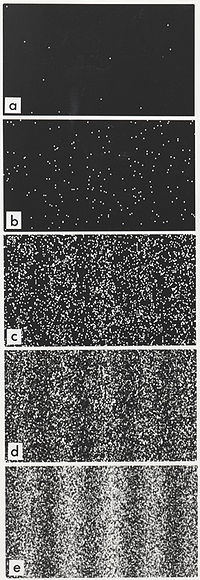
At first you see single photon marks on the screen, but as they build up an interference pattern emerges. Remember, you were only shooting one photon at a time, but now we see an interference pattern. This means that the photon is interfering with itself! If you shine the photons through a single slit no such pattern emerges. It seems that each single photon has to be going through two slits. If that isn’t strange enough for you, then how about the fact*** that this pattern of a single thing interfering with itself has been demonstrated with not just “massless” photons but with electrons, protons, even molecules as large as Buckminsterfullerene.**** Even a Buckyball can cancel itself out!*5*
OK, so light acts as a wave, and light acts as a particle*6*, ‘it just depends on how you look at it’. Do an experiment looking for the wave nature, and you’ll find it. Do one looking for the particle nature, and instead you’ll find that. What’s the big deal? The big deal is that, if you’ve just accepted that, then you’ve accepted that ‘Reality’ is defined by the observer. If ‘Reality’ is defined by the observer, then what the heck is ‘Objective Reality'? What good does it do to look outside yourself for confirmation or disconfirmation of your prejudices*7*?
There is an alternative. That alternative is to reject the LEM*8*. In logic terms the LEM states that either A or not A is true for all things – every proposition is either true or it is false. Everything must be one or the other. This is so basic a premise as to almost not even need to be stated for some. Ah, the LEM, what a powerful principle. Many a logic proof I short-cut by assuming the opposite of my conclusion, proving an absurdity, evoking the LED & smugly stating QED. I think that the LEM, and its acceptance, often so profoundly accepted as to be not even considered as possibly erroneous, gets at the heart of what's wrong with 'Reality'.
'Reality' is an illusion.
This illusion results from the assumption of the LEM and a short series of syllogisms. I will develop this in a later post, as this one has already become unwieldy, and I do not want this very important point to get buried at the bottom of a post.
---------------------------------------------------------------------------------
*Einstein was almost certainly not an Empericist. For one, he developed Relativity based on what are called thought experiments (Gedankenexperiment or Gedankenversuch) and which occur entirely within the mind, without the laboratory. Relativity toppled Newtonian physics, which is evidenced all around us. Nonetheless, Einstein used pure reason to conclude that Newton was wrong. What's more, when asked what he would do if the first experimental tests of Relativity did not agree with his predictions he said something like, I will feel sorry for the experimenters - the theory is too beautiful to be wrong. Additionally, even though the Photoelectric Effect gave birth to Quantum Physics (QP) Einstein never accepted the conclusions of QP that did not jive with the Determinist philosophy. For the latter part of his life was regarded by his colleagues at Princeton’s Institute for Advanced Study (with the quite notable exception of Gödel) as cute but antiquated sort of scientific dinosaur.
**The diagrams in this link show nicely demonstrative pictures of constructive and destructive interference patterns.
***'Fact', as in something observable and reproducible and available to anyone who should care to look for it.
****Buckminsterfullerene, aka the Most Beautiful Molecule (though personally I'm partial to porphyrins, which form the business end of hemoglobin as well as chlorophyl and have a wonderful symmetry), aka the Buckyball is composed of 60 carbon atoms arranged in a graphite-like structure that curves lack on itself forming a ball that “looks like” this:
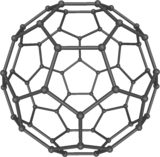
*5*Perhaps it shouldn’t be any more remarkable that a Buckyball can cancel itself out (create an interference pattern with areas of negative interference) than it is that photons or electrons can do this, but it really amazes me. I just imagine spacetime making a sort of slurp/sucking sound as the soccer-like Buckyball vanishes. And if this happens for Buckballs, then it would seem it could happen for anything, baseballs, humans, galaxies…etc. For this reason I always try to keep only one door in my house open at a time.
*6*And, as you’ve seen above, so does everything else.
*7* Someone please answer this for me. It feels like it must be a good thing to do, but I can’t articulate how or why.
*8* aka principium tertii exclusi, aka priciple of bivalence, aka a bunch of other things
Tuesday, July 7, 2009
Though it's unlikely anyone was confused, allow me to clarify.
I am not reading the Wikipedia page on Infinite Jest, I'm reading the book. Rather, I'm reading the words printed in the book. And I suppose if I'm going to take it there I should admit that, so far as "I'm..." refers to what my person is presently engaged in, I'm typing words on the keyboard of my MacBook.
OK then
I am not reading the Wikipedia page on Infinite Jest, I'm reading the book. Rather, I'm reading the words printed in the book. And I suppose if I'm going to take it there I should admit that, so far as "I'm..." refers to what my person is presently engaged in, I'm typing words on the keyboard of my MacBook.
OK then
Saturday, July 4, 2009
Friday, June 26, 2009
Monday, June 22, 2009
This raises the question of thought's relation to language. Can one have a thought which is not framed in a language of some sort, be that language English, Algebra, the diatonic scale, etc? It would seem that one could, otherwise pre-verbal children and our ancestral forbearers never had a thought. What's more, if thought never existed before language, then what was the impetus for language? While it seems to me that thoughts must be possible without a language to frame them I cannot think of ever having had a thought without it being in a language. Thinking within a language would seem to put up a fence around one's thoughts*.
If something cannot be expressed with the languages one uses, can it still be thought?
--------------------------------------------------------------------
* Albeit a very, very large fence. At it's 1st publication the Oxford English Dictionary had 414,825 entries. So what language can express is infinite but bounded - infinite, because, as German demonstrates sometimes beautifully, but often quite cumbersomely, we can combine preexisting words to form new words, and there is no end to this. Yet it is bounded, because language can only express what can be said with words and syntax. Words such as indescribable clearly show that we are aware of this.
If something cannot be expressed with the languages one uses, can it still be thought?
--------------------------------------------------------------------
* Albeit a very, very large fence. At it's 1st publication the Oxford English Dictionary had 414,825 entries. So what language can express is infinite but bounded - infinite, because, as German demonstrates sometimes beautifully, but often quite cumbersomely, we can combine preexisting words to form new words, and there is no end to this. Yet it is bounded, because language can only express what can be said with words and syntax. Words such as indescribable clearly show that we are aware of this.
Thursday, June 18, 2009
Here I am trying to consider the nature of knowledge (thinking about thinking) and in doing so I discuss the limitations and meaning of discussing such matters (talk about talking about it). So it's no wonder that I often trip over the shoestrings these thoughts hang from. A considerable source of difficulty (SOD)* is that I can say but one thing at a time, but each idea that I want to express has other thoughts branching from it, and those tangents have tangents with tangents. To try to write the one thought without giving attention to its florescence is like stripping a beautiful plant to its trunk so that it can be fit through a trunk-sized hole (not to overstate the appeal of my ramblings by using words such as beautiful).
So, on the nature of knowledge:
"Know" is a word which, for my tastes, is used entirely too casually by most people. It can mean to be familiar with, and in that sense I don't object to its daily use. However in the sense, "to apprehend clearly and with certainty" the word has almost no place in any quotidian experience except to mention its absence. In this sense, to know implies not just an acquaintance with fact or truth, but also the existence of "facts" or "truths".** What does it take to be acquainted with unquestionable truth?*** Here faith or mysticism and science or logic seem to diverge. Faith and mysticism seek to behold truth while science seeks to know truth. I would argue that this is a fool's errand, or at least one for Xeno's Achiles****. Since to know requires the removal of all doubt one must discard any assumptions(, for the veracity of these assumptions can always serve as a source of doubt. Even the exhaustive empericist would be forced to admit that at the base of his or her epistemological scaffolding lays the Principle of Induction (PoI). The PoI is a principle that we use so often most of us don't even consider it. Basically, the PoI states that if something has happened a certain way many times before then it will happen that same way the next time. To borrow an example from David Foster Wallace*****, you exercise the PoI every time you get out of bed. You assume that the floor will be there to hold you up, but how do you know that it will? Simply because it has every other time you've stepped out of bed. Is this an unquestionably valid assumption? Is it inconceivable that your floor has rotted and will give way under your feet, or that your bed has been secretly moved to a precipice, or that a knowledge gnome who seeks to undercut the PoI has secretly cut a hole in your floor while you slept? It may be a safe assumption, but it is not an unquestionable one. It's an assumption that most of us make not just daily, but with nearly every decision we make. Doubting this assumption can literally drive you crazy (see the quote on paranoia from a few days back), so I don’t recommend doing so. However, if absolute certainty is what you seek, doubt it you must.
This is why to seek to know, in it's truest sense, is a fool's errand, it can never be done unequivocally.
But for the sake of discussion, let's assume that my dog Carl produced a simple, eloquent, assumptionless and irrefutable proof of the PoI. We now have firm ground to start with, but if we intend to use observation and deduction to proceed, we must consider both of these activities******.
-----------------------------------------------------------------
*I intend to use S.O.D. repeatedly here, for these sources of difficulty can be rather demonstrative of other philosophies and the one that I am trying to understand/develop here, so please keep the acronym SOD in mind.
**I must table this question for later. To discuss it here would be to derail the post before it got anywhere. Nonetheless, it is a very interesting question indeed.
*** "[U]nquestionable" it must be, or else it is not "known".
**** Zeno's paradoxes are well-known to most middle schoolers, even if not by name. "In a race, the quickest runner [Achilles] can never overtake the slowest [the tortoise], since the pursuer must first reach the point whence the pursued started, so that the slower must always hold a lead." (Aristotle) Zeno was a Greek who confounded many of the basic concepts of the time such as motion. His paradoxes characteristically involved infinities or their converse, infinitesimals, and in discussing epistemology I often find myself in my own race with the tortoise of expression or clarity - it seems that each step towards my goal introduces another step to be taken. Some consider paradoxes to be a product of the assumptions we make or the meanings we affix to concepts that would be better served to be discussed with meaningless formalism (purely syntactical). I disagree. I think paradoxes arise by asking senseless questions that only appear sensible because of unrecognized assumptions or false syllogisms. For more on this see my yet-unwritten post on "Reality" and its own SODs (I guess that the plural of SOD should be SsOD, eh?).
*****
1-RIP
2-A DFW footnote, how appropriate.
3-This example is borrowed from DFW's Everything and More, a book on infinity, which is fantastic, but also difficult, and is the book that started me down the path that led to this blog. Really, you should probably just read that book and its suggested readings instead of this blog, as most of what's here is a dumbing-down of what's there.
******w/r/t Observation we will need to consider Heisenberg’s Uncertainty Principle (another S.O.D.) and this certainly deserves more than a footnote, so stay tuned. Deduction, well I may get to that next, or not, but if I wait until I’ve tackled deduction to post this then you’ll all have stopped checking back by the time I do…so once again, stay tuned.
So, on the nature of knowledge:
"Know" is a word which, for my tastes, is used entirely too casually by most people. It can mean to be familiar with, and in that sense I don't object to its daily use. However in the sense, "to apprehend clearly and with certainty" the word has almost no place in any quotidian experience except to mention its absence. In this sense, to know implies not just an acquaintance with fact or truth, but also the existence of "facts" or "truths".** What does it take to be acquainted with unquestionable truth?*** Here faith or mysticism and science or logic seem to diverge. Faith and mysticism seek to behold truth while science seeks to know truth. I would argue that this is a fool's errand, or at least one for Xeno's Achiles****. Since to know requires the removal of all doubt one must discard any assumptions(, for the veracity of these assumptions can always serve as a source of doubt. Even the exhaustive empericist would be forced to admit that at the base of his or her epistemological scaffolding lays the Principle of Induction (PoI). The PoI is a principle that we use so often most of us don't even consider it. Basically, the PoI states that if something has happened a certain way many times before then it will happen that same way the next time. To borrow an example from David Foster Wallace*****, you exercise the PoI every time you get out of bed. You assume that the floor will be there to hold you up, but how do you know that it will? Simply because it has every other time you've stepped out of bed. Is this an unquestionably valid assumption? Is it inconceivable that your floor has rotted and will give way under your feet, or that your bed has been secretly moved to a precipice, or that a knowledge gnome who seeks to undercut the PoI has secretly cut a hole in your floor while you slept? It may be a safe assumption, but it is not an unquestionable one. It's an assumption that most of us make not just daily, but with nearly every decision we make. Doubting this assumption can literally drive you crazy (see the quote on paranoia from a few days back), so I don’t recommend doing so. However, if absolute certainty is what you seek, doubt it you must.
This is why to seek to know, in it's truest sense, is a fool's errand, it can never be done unequivocally.
But for the sake of discussion, let's assume that my dog Carl produced a simple, eloquent, assumptionless and irrefutable proof of the PoI. We now have firm ground to start with, but if we intend to use observation and deduction to proceed, we must consider both of these activities******.
-----------------------------------------------------------------
*I intend to use S.O.D. repeatedly here, for these sources of difficulty can be rather demonstrative of other philosophies and the one that I am trying to understand/develop here, so please keep the acronym SOD in mind.
**I must table this question for later. To discuss it here would be to derail the post before it got anywhere. Nonetheless, it is a very interesting question indeed.
*** "[U]nquestionable" it must be, or else it is not "known".
**** Zeno's paradoxes are well-known to most middle schoolers, even if not by name. "In a race, the quickest runner [Achilles] can never overtake the slowest [the tortoise], since the pursuer must first reach the point whence the pursued started, so that the slower must always hold a lead." (Aristotle) Zeno was a Greek who confounded many of the basic concepts of the time such as motion. His paradoxes characteristically involved infinities or their converse, infinitesimals, and in discussing epistemology I often find myself in my own race with the tortoise of expression or clarity - it seems that each step towards my goal introduces another step to be taken. Some consider paradoxes to be a product of the assumptions we make or the meanings we affix to concepts that would be better served to be discussed with meaningless formalism (purely syntactical). I disagree. I think paradoxes arise by asking senseless questions that only appear sensible because of unrecognized assumptions or false syllogisms. For more on this see my yet-unwritten post on "Reality" and its own SODs (I guess that the plural of SOD should be SsOD, eh?).
*****
1-RIP
2-A DFW footnote, how appropriate.
3-This example is borrowed from DFW's Everything and More, a book on infinity, which is fantastic, but also difficult, and is the book that started me down the path that led to this blog. Really, you should probably just read that book and its suggested readings instead of this blog, as most of what's here is a dumbing-down of what's there.
******w/r/t Observation we will need to consider Heisenberg’s Uncertainty Principle (another S.O.D.) and this certainly deserves more than a footnote, so stay tuned. Deduction, well I may get to that next, or not, but if I wait until I’ve tackled deduction to post this then you’ll all have stopped checking back by the time I do…so once again, stay tuned.
Subscribe to:
Posts (Atom)